Monday, March 25, 2013

Democracy Facing the Test...

Malaysia was founded on the basis of a belief in parliamentary democracy with monarchy as a superstructure in its governance. We have the Paramount Ruler (the Yang diPertuan Agong) as the supreme Head of State while the Prime Minister is the Chief of the elected government with a cabinet of Ministers as his council of advisors. The lower and upper house of parliament sanctioned all the laws in the country as endorsed by the Agong. Members of Parliament and all State Assemblies are elected by the people, though the Prime Minister, his Deputy, the Ministers, the Chief Minister of a State and the members of his Executive Council (Excos) are selected and appointed by the party with the endorsement of the Agong or the Ruler of State (the Sultan) as appropriate.
more of this

The real democracy as such is only in the election of the members of Parliament and the State Legislative Assembly, The electorate has no say in the selection and appointment of the PM, DPM, the Ministers, Chief Ministers, Excos etc and other political appointees in the government. The people have no says in who actually would become their Prime Minister, Deputy PM, Ministers etc.They just choose the candidates fielded by the political parties, whether from the party now holding the seat of power or from the opposition. The party will decide who'd be the PM and he will determine the rest with the agreement of the party's bigwigs.
or this

Thus the election or the poll takes the full brunt of the democratic process. Once you've made your choice at the poll, you have no more say as to who will run which part of the government i.e. which ministry or who will hold what portfolio. The PM as chosen by the party will decide on the members of his Cabinet and he can choose them from the elected members of Parliament or even from outside through appointment as a Senator - a member or the upper house of Parliament. When a Minister is not an elected member of Parliament, ipso facto not a representative of the people or the electorate - one wonders whether he is only responsible to the PM and the Cabinet and not to the people as a whole?
the rural beauty

The coming General Election, therefore, is a real test of the Malaysian style democracy which had withstood the test of time so far and brought the nation considerable progress.The difference this time around is that the opposition parties have formed their own coalition and are not standing alone as before. And they have also been running four state government after their victory in the 2008 general election. As such they do not enter the poll without any solid footing in terms of governing power or a performance record of their own. Good or bad, it's up to the people to judge. The government in power of course has a long track record of more than 50 years by which to be judged. It has embarked on a wide ranging political, economic and social policy of TRANSFORMATION as against the opposition's battle cry of REFORMATION.

What the two ideologies entail is a matter of intellectual rationalization and imagination. Datuk Seri Najib's transformation programs seem to cover all aspects of governance i.e. political, economic, social, administrative, and even cultural. They cover such an extensive field of concern that results may not be quite obvious as yet except on a short term basis. Is there any real transformation or change in UMNO's way of doing things, for example, especially in relation to awarding contracts and sharing the benefits of mega projects being churned up by government? Is there any change in the tuan-like attitude of appointed leaders at the grassroots level, especially the "ketua kampung"? The overbearing image of the rich putra-UMNO created in the past has not seemed to decrease but on the other hand seemed to increase in number and prosperity. Other programs such as the BRIM, special funds for many things, and the salary revisions have, of course, received a resounding acclaimation from those who received immediate cash returns. But their result in boosting up the productivity of the nation is still to be seen. One sure result is that the price of things has and will continue to rise.

Reformasi (reformation) is till more of a battle-cry than a solid package of development programs. More disturbing is the fact that the coalition formed by the opposition seemed to be so brittle. The leaders are often at loggerhead with each other. It's strength lies in the hope that 'a new broom can sweep well', and that 'something new is better than more of the same thing'. To experiment with a new form of government is a very risky thing but then 'nothing venture nothing gain' as the saying goes. The public has seen a stable government ruling the county for more than half a century and no one can doubt the progressive changes it has brought us. The question: is it the best that can happen or can we do better? That is the issue and the choice which faces the democracy in Malaysia.

Saturday, March 16, 2013

The "Rich" Kampung Boy.

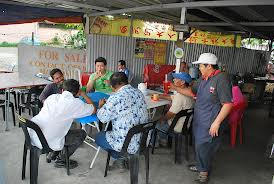
Everyone is happy at the village coffee shop we call "Kedai Hassan". The old men, the old and young single mothers, the young men and women who are employed, the young men and women who are not, and even the students. They are all talking happily, some waving a piece of paper, some a form of coupon. They are beaming and "brimming" with joy. Because of BRIM2. Everyone is having at least RM200 in his or her possession, as promised by the government.

Oh yes, the government is very kind and sensitive to the need of us poor folks, was the general acclamation.Never before had we been given cash supplement just like that. No question asked as long as you can prove that your income is less than RM3000 pm. Which practically includes everyone in the kampung. Even the students are give a cash coupon to buy books and other educational accessories. Which nowadays include a handphone. Next we're going going to ask the government to give each of us a PC. Later on maybe a Kancil or MYV, used ones perhaps....

It's so refreshing to see the happy faces in the kampung.The only complain is why some got their letter of approval and order to get their cash earlier than some others."He has got ties in higher cicle, that's why," was one of the familiar comments heard. There are some ignoramus who just heard about the cash assistance by government and had not applied. Friends crowded around him or her to help. Even a senior looking gentleman who just emerged from a new Proton Wira was asked by some friends in "Kedai Hassan" whether he had applied for the RM500 'Bantuan Rakyat 1 Malaysia' (BRIM). When he said that he was not eligible, his friends roared out in a teasing laughter. "So many others like you got it, Brother. Why waste the money? Let me apply it for you and we can share the dough, okay?"
Incidebntly, Kedai Hassan seems more crowded now than before and a small corner stall has also metamorphosed into a full-fledged coffee-shop to cater for the expanding BRIM-talk (lepak BRIM) sessions.

Lahad Datu for a while had captured the number one topic of discussion in Kedai Hassn. 10 members of the security forces killed agains 60+ terrorists, was no joke. Tempered flared and wild accusations smoldered, with blame being placed on almost everyone including the Malaysian and Filipino governments, the self styled Jamalul Kiram III, the Opposition party, Nur Misuari, the US government which seemingly ditched a battleship full of modern firearms on a barrier reef in the Sulu Sea, and even on the old architects of the Malaysian nation. One can laugh at the silliness of the accusations but there are those who nodded seriously in agreement with the speaker.

Nevertheless the BRIM2 jubilation overtakes all. With the cash in their pockets or the promise of the money to come, Kedai Hassan and other sudry shops experience a boom in their business and that is good.Talk about the forthcoming GE is peppered with the hope that the government will give out more goodies before the election. The salary increase for the police and military is a good example of the sudden magnanimity. As the flags and buntings heralding the forthcoming GE begin to crowd the scene, the village folks expanded their hope on getting more cash assistance from the government, more subsidies, and more free "makan" from the YBs ( peoples' representatives in the Federal and State Legislative Assemblies). The merit and appropriateness of policies currently adopted by government, the promises of the Opposition in its Election Manifesto, and all the national issues now faced by the nation, seem to be drowned by the BRIM2 jubilation.

So when is BRIM3 coming? I guess everyone in the village and also the <3k earners in the towns and cities are waiting for that.It certainly gives a fleeting sense of being "rich" to the village folks,like the new revision of salaries.

Friday, March 8, 2013

Armed Insurgence into Malaysia

A self proclaimed Sultan of Sulu, Kiram III, had managed to send some 200-250 armed rebels into Sabah. They were called members of the Royal Army of the Sultan, charged with the responsibility of reclaiming certain parts of Sabah including Lahad Datu and Semporna, as part of the Sultan's territory. One will remember that the Philippine's government laid claim on Sabah way back in 1963 but the claim was later dropped. The claim of the Sultan of Sulu disappeared with that. But after the Philippine's government awarded a self governing status to Southern Philippines with Malaysia acting as the peace negotiator, the claim was suddenly revived, raising many questions as to why so.
the dead heroes going home

It looks ludicrous at first for an old Sultanate to proclaim a piece of a sovereign and independent nation as its territory, especially since the Sultanate is not recognized in its own original kingdom.And also when only a few hundred 'soldiers' were sent to infiltrate the nation. But this ceased to be a joke when a total of eight policemen including high ranking officers, were killed by the 'soldiers' now proclaimed as armed terrorists by the Malaysian government as against 52 members of the band already killed by the police and members of the security forces mobilized to give assistance. The terrorists had also intermingled with the local residence of the villages in the area, who themselves mostly originated from the Philippine but have acquired a citizenship status. Thus the job of sieving out the terrorists from the villagers when unarmed could be very difficult.
others ready for action

Malaysians are angered not only because of the armed intrusion but because of the intrigues used to ambush members of the recognizance team and the brutal way those captured were tortured and killed. The way they treated the dead bodies also showed that they might not be good Muslims, if they were Muslims at all. Could they merely mercenaries hired to create trouble for the government on the eve of a general election? The number of people killed i.e. 8 policemen and 52 of the terrorists, seems to be too high a cost for such a political gimmick.
the mpv ready for action

Malaysia certainly faces the problem of getting enough skilled and semi-skilled workforce to implement its development programs especially in relation to some of its mega-projects.As such foreign workers had been allowed to come in quite freely from Indonesia, Bangladash, Cambodia, the Philippnes, India etc. Some, especially the Indonesians, Filipinos, Indians and Chinese have been living in the country for so long that they have been awarded a citizenship status. In the case of Sabah and the eastern part of Malaysia, it has been home to so many Fili[inos since before the establishment of Malaysia that to separate the citizens and the new comers or intruders would be most difficult. Any attack by the security forcers on villages known to be occupied by the armed intruders could result in a high level of 'collateral damages'. What more if the intruders have resorted to holding local residents as hostages.

The situations seems to resemble the days of communist terrorism in Peninsula Malaya when it was so difficult to differentiate between local Chinese residents and the Chinese terrorists. Sir Gerald Templer finally decided to group the local Chinese in fenced-up New Villages heavily guarded by the security forces.We hope that it would not be necessary to do so in Sabah in order to protect the bona fide local residents from harassment by the armed and obviously vicious intruders. We all hope and pray that a peaceful solution can be found to the problem by calling on the self-proclaimed Sultan Sulu to call off his futile act of reclaiming lost territory through an armed struggle.

Saturday, March 2, 2013

Basic Principles in a Political Coalition....

We hear a lot of wranglings in PAKATAN, internal conflict and disagreements, which are often highlighted by the mainstream media. Keadilan-PAS-DAP seemed to be always gunning at each other, challenging each other, provoking each other.That does not seem to be the case in BARISAN. However, once in a while we see things even in BARISAN, going in opposite directions. But, the differences are quickly dispelled.Both coalitions are what coalitions in politics should be- a political marriage of interest and convenience.

In theory the marriage is supposed to result in a strong government with a good representation of all segments of society in the electorate. Conflicting interests, demands and ideologies would be discussed within the coalition and a decision acceptable to all would be taken, thus keeping the conflicts and disagreements within the coalition, preventing them from rocking and splitting up the public as a whole.Thus, it is most natural and even necessary for conflicting interests and demands to be discussed WITHIN the coalition. It is in there that the war will be fought and a compromise attained, to be announced or presented to the electorate as a policy of the coalition party. If, after the announcement, some members of the coalition chose to disagree and continue to attack the decision of the coalition, they should be considered as 'defaulters' and 'turncoats'. Individual member party in the coalition should then take action on the 'defaulters'.

So, why are we so concerned with conflicts and disagreement within the coalition? They are supposed to be the problems of the coalition party to be handled by its leaders. Why are we so concerned with the disagreements between Keadilan, PAS and DAP on certain issues of governance since what really matters is the final policy adopted by the coalition? If you as a member of Keadilan, PAS or DAP don't agree with the policy announced and adopted by the coalition (PAKATAN), then it's a matter which must be resolved between you and your party. This goes for members of UMNO,MCA,_MIC etc in BARISAN as well. If BARISAN had less disagreements in the coalition, less wranglings and less discussions, it does not necessarily mean that every member in the various component parties agree with the policy adopted. Trainers in group dynamics will attest that less vociferous and heated arguments in a group often indicates that the decision of the group may not be supported by all its members. The rowdier and more heated the discussions, the higher is the chance for getting better support from all.

If the concept of coalition parties as assumed above is correct, then we should expect higher levels of discussion and disagreement within the coalition, BEFORE coming out with a policy statement. If on the other hand a coalition is merely a marriage of convenience, it will certainly end up on the rock, sooner or later. The concept of a coalition should be thoroughly understood by political parties and their leaders if the coalition is going to last and serves its purpose well. BARISAN has withstood the test of time in that regard but although not much of the internal struggle is known, little discussion and disagreement could mean that much is being swept under the carpet. PAKATAN on the other hand should adopt the true principles of coalition more if the coalition is going to last and serves its purpose. Otherwise, it will break up even before the GE13 contest.

Sunday, February 24, 2013

English as a Second Lamguage.

Many of the third world countries have adopted English as the second language. That includes Malaysia. For msny countries it's the language of the elites, the educated and admirers of the western culture.It's almost impossible to accept English as a common medium of communication without accepting the culture that comes with it.

English used to be a compulsory subject in all secondary schools using English as the medium of instruction. Fail English in your final year examination and you fail to get your School Certicate or now known in Bahasa as the SPM (Sijil Persekolahan Malaysia). It was also difficult to get a job without a "C" or a credit in English as shown in your School Certificate results. And many students failed to get it although they did pretty well in other subjects.

The requirement was changed to a "C" in Bahasa Malaysia after Malaysia became an independent nation. The policy-change shifted attention from English to Bahasa and surprisingly many Malay students failed to get a credit in their mother tongue. The National University of Malaysia or UKM came into being with Bahasa as the medium of instruction and the National Language Agency began the uphill task of updating and improving the language to cope with the need of development. Like Indonesia, several English words were adopted with some changes in the spelling, to express concepts and ideas not
familiar to the Malaysians. As Malaysia entered a new era of development, more and more English words entered the Malaysian vocabulary, some of which were Malaysianized while others were not, resulting in near chaos. Some of the local words introduced by the National Language Agency to be officially used as the English equivalent were not commonly known to Malaysians and never became as popular as their English origin. The mix of Bahasa and English in the everyday parlance of the educated Malaysians then became rather confusingly ludicrous, especially to those not educated in the English medium.


Bahasa Malaysia became the official language of the country to be used in all official functions and the use of English words was widely accepted when the Malay equivalent could not be found. The standard of written and spoken English in the country then began to deteriorate since the Malay-English mix became so common and quite acceptable.The pronunciation of the English words with a Malayanized slang and intonation was also accepted while all grammatical rules in the English language were thrown to the wind. This also happened in the schools and regretfully in the institutions of higher learning including the universities with English as the medium of instruction but allowing Bahasa to be used as an option.

And so today, the standard of English as used by many Malaysians including young teachers, is found to be lamentable if not abnoxious. Malaysian English (or Manglish) has become popular to the detriment of using English as an effective and proficient way of communicating at the international level. Some of the new graduates from our universities using Bahasa as the medium of instruction could not even communicate in English, thus unable to express the concepts, ideas and terminologies introduced by today's civilization and way of life. For a while science and mathematics have been taught in schools through the English medium. But that has neither improved the ability to communicate in English among the students nor their grasp of the subjects. It also contradicts the goal of establishing Bahasa as the national language.

Now the government is not only recruiting English teachers from England (and soon from India) to help Malaysian students master the English language again, but also intends to make English a compulsory subject in their studies like the time before independence. It seems that we are going back to the "good old days" when a student in an English medium school could be fined for speaking in Bahasa. It is as though that after more than fifty years of independence Malaysia has not been able to train their own experts in the English language. Maybe the TV program 'Mind Your Own Language' should become a compulsory watching subject in the schools now.Otherwise we will specialize in broken English while people in other countries with English as a second language speak fluent English but with a local pronunciation and intonation.

Friday, February 15, 2013

Resurgence of the Kampung

At one time villages or the kampungs in Malaysia were famous as places of quietness and serenity, places free from the hustle and bustle of city life, places of recluse and self-indulgence. Then rural development began to change the scene, turning the kampungs into fair grounds for economic resources and opportunities. Rice fields and horticulture were given up in favor of exploiting rubber and palm oil production.The young people moved en masse to the towns and cities leaving the old folks and the very young in the village. to be taken care of by their grand parents for the parents were too busy earning a living or making a fortune in the cities.


We began to see old traditional houses left to rot and land holdings becoming secondary jungles. As we enter into the first decade of the 21st century, more and more traditional houses along the main roads (what more in the rural depth) became vacant and left to the pleasure of white ants since the grannies occupying them had passed away. Sons and daughters of the new era were not interested in going back to the villages to take care of the old properties. Only when the land left by their parents or grannies are packed with fruit-tress such as durians, rambutans, mangoes, mangoestein etc would they go back during fruiting season to get their supply of free fruits, which in the towns and cities would cost them a bundle.


Many have also bought their own houses in the town and city areas where new housing communities are springing up like mushhrooms, The interest in going back to the village slipped even further down their list of priorities.

But as the cost of houses and land in the city area skyrocketed towards the end of the first decade of the 21at century, and also the cost of almost everything including food and fruits, the attention of the ex-emigrants from the villages began to refocus on their places of origin. Tired of what the cities could offer as entertainment with costs rising twice of threee time ( take the cost of cinema tickets for example), they began to go back 'home' for rest and recreation. Many are floored to see the dilapidated remains of their old homes and birthplaces and began seek new place to build a 'summer' home or a 'retirement' home if they had not been able to buy one in town.Even with the rising costs in the villages for building houses and for domestic expenditure, they are much lower than what you have to pay in town.

And so began the rural resurgence - old and young ex-emigrants from the kampungs going back to the kampungs to salvage properties claimed by the jungle or the white ants. On weekends you can see several cars now in the compounds of the dilapidated homes with works being undertaken to repair the old homes or build anew in the same or nearby spot.More interestingly we can see the urbanized old and young people clearing up the compound of the old homes now overgrown with wild elephant grass, thorns and ferns, raking up and burning away the rubbish, using knew and old farming equipment. And while they works, we can see their own offspring sitting in the shade - if the old house is still not for for occupation - with their handphones or I-pads. A very heartening and sobering scene indeed for the old folks who had remained in the village all their life.


The old village forks are happy to see the kampungs coming up alive again, even if only on weekends and during public holidays. But when all the ex-emigrants of the village returned home to their birthplace, who will be left to populate the town and cities? At the rate the cost of housing and landed properties is going up, more ex-village emigrants will certain go back home (balik kampung),leaving the towns and cities to the rich business people....

Friday, February 8, 2013

Freedom of Thoughts and the Press


Freedom of the Press in Malaysia received a very low rating by the Reporters Without Border (RWB) report for 2013. It's rated lower than the freedom of the Press in countries like Zimbabwe,Fiji, Oman, Cambodia, Vietnam etc. The reason seems to be that the mainstream news media (MNM is owned by the government and while pro-government news is played up, news and views from the opposition parties are played down or even stopped from reaching the public. Though the informal news media as provided by the Internet is now very active, the information from this source is always taken with a pinch of salt.


Does a lower level of Press freedom also mean less freedom of expressing views and thoughts by the public?

The mainstream news media (MNM) certainly set the standard for freedom of speech and expression of thoughts in any country. When the mainstream news media (MNM)itself is clearly biased by being too pro-goveernment,people's thinking can also become biased. They can see that MNM is not presenting the whole truth about anything and that there's too much of propagsndizing going on. This becomes more and more obvious as other informal news media come out with the opposite of what the MNM prints. The more propagandistic the MNM becomes the greater will be the distrust generated among members of the public.

By the same token views contrary to or opposed to those expressed by the MNM will be suppressed or, if carried by the informal media, will be nullified.Truth becomes more and more illusive unless the views expressed by the MNM is accepted as such without any doubt. Everything and anything which runs contrary to those expressed by the MNM will be condemned, censored or proclaimed as false and untrue. The public and the ordinary men-in-the-street will little or no chance of airing their views which run contrary to those accepted by tne government.

Such a situation will certainly banish public debate on any controversial national policy, program and government's action. All discussion will be confined to explainingg and extolling the government's stand. The public will become more and more sceptical of all government programs since there is no critical review at all, or otmherwise become very gullible. Critical thinking will become dead since it will be dangerous to do so. Even in schools, colleges and universities critical thinking wiil be shunned and suppressed as it is considered dangerous. Gatherings to discuss policies, programs and issues would not be allowed if held bey parties not supportive of, what more opposed to the government.

What will the nation become then? What will a nation become when there is no critical thinking to stop the government from undertaking policies and programs which are considered wasteful and counter-productive? There will inly be 'yesmen' and zombies.

Truth will only emerge when there is contraversy, critical thinking and public debate on anything that affects the life of the people in the nation. Otherwise, when it finally does emerge, there can only be regrets and disappointment.

Let's not allow our nation to drift in that direction. Let's have more freedom of thoughts and opinion, and freedom of the Press. The mainstream news media should be more tolerance of views and opinion contrary to those adopted by the government while the informal news media should be more objective and factual in presenting their arguments and criticism. Only then could freedom of thoughts and critical thinking be promoted in the nation.